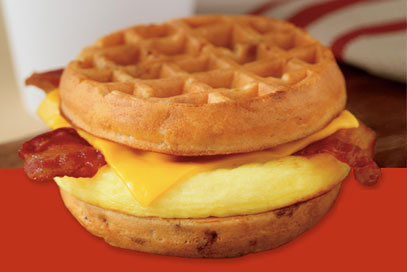
Ever since my early years, I've had a strange infatuation with advertisements depicting hyper-real food. The proclivity turned into near obsession during an internship writing copy for a prominent advertising agency around 2003. I learned how these ads tap into the dopamine of consumers. See the melted cheese and perfect egg above, oozing in tranquil formation. The bacon pops out like a crisp polo collar resting over a J-Crew sweater. The waffles pretend to be bread, a bagel, flapjacks or an english muffin and can mutate into whatever the consumer really wants for breakfast. The... WAIT... WAFFLES?!
I've been noticing the ads for the product above throughout our lovely subway system. Dunkin' Donuts has stepped into (or perhaps invented) a completely new realm of breakfast sandwich discovery. Let's imagine the meeting:
CEO: What do we have that can compete with McDonalds? Bodegas? Starbucks?Lackey: Hey, how about we make an egg mcmuffin/McGriddle crossbreed, but instead of the muffin we soak two large waffles in maple syrup and use that as bread?
The idea is so bizarrely simple that the question becomes: How could it have slipped through years of product development and marketing meetings? Probably because it's one of the most overloaded combinations of food ever put into one item. Yes, you could easily have a breakfast with two waffles (slathered in lush syrup), two pieces of bacon, plus an egg mixed with cheese. But, why put them all together? Are we that lazy?
The obvious primary influence on Dunkin' Donuts' innovation besides the McGriddle is the KFC Bowl - a head-scratching bucket of slop that has become their most popular menu item. It's nearly the same concept, but for lunch and dinner. Pile everything on the menu into a bowl, mix it up and eat with a spoon. It's absolutely disgusting as an abstract concept, and I can't imagine the actual thing tastes much better. Photographs - like the one above, which makes the waffle sandwich look like a celebrity - are amazing, but can't do much justice to the idea when put through systematic logic.
I also feel that it's worth nothing that my favorite hyper-real food campaign of all time was an effort from Jack In The Box in 2006. It was perfectly placed on a bulletin board in the back of our literary theory class at the UofA, and featured a giant burger bursting with swagger out of its vegetable clothes, only held together by goliath slices of ciabatta bread. The tagline: BREAD IS BACK!!!! Where did it go? Did Atkins and the low-carb missionaries kill it off in some sort of crusade against carbs? I suppose so. Like a movie, everyone can debate the merits of hyper-real food. I'll be at Dunkin' tomorrow morning for those who want to discuss more.
